Getting Your Focus Back: 4 Small Steps That Actually Work

Last month, I caught myself doing something strange. I was simultaneously watching a YouTube tutorial with one eye, replying to Facebook messages, and trying to outline a client project. None of these tasks was getting my full attention. Worse, I couldn’t seem to focus on just one thing for more than a few minutes without feeling an almost physical pull toward one of the others.
It wasn’t always like this. I used to be able to work on something for hours without checking my phone or jumping to another tab. Somehow, my ability to focus had quietly eroded, slice by tiny slice, over the past few years.
You might be experiencing something similar. That sense that your attention has become fragmented – split into smaller and smaller pieces until no single activity gets your complete focus anymore.
The good news? This isn’t permanent. Focus is like a muscle that can be rebuilt, even after it’s weakened. Here’s what worked for me, and how you might find your way back to deeper concentration too.
What Actually Happens to Our Focus
I used to think I was just getting worse at concentrating. But after talking with other digital professionals and experimenting with my work habits, I realized something: my brain hadn’t fundamentally changed – my environment and habits had.
Think about how we typically work now. Multiple chat apps sending notifications. Phones buzzing. Emails popping up. News alerts. Meeting reminders. Each one takes just a sliver of attention, but together they create a constant state of partial focus.
For me, this crystallized during a project last year. I was tasked with writing website copy, something I’d done countless times before. But what used to take me a solid afternoon now stretched into days of fragmented work. The writing itself wasn’t harder – maintaining focus on it was.
This isn’t about willpower or discipline. It’s about how our digital environments have shaped our attention patterns. Each small interruption doesn’t just take the moment it occurs – it creates a ripple effect of distraction that continues long after the notification is gone.
Simple Changes That Rebuilt My Focus
After realizing I had a problem, I began experimenting with different approaches. I didn’t want complex systems or drastic measures – just practical changes that worked with my actual life. Here’s what made the biggest difference:
1. The Focus Container
Instead of trying to force myself to focus for long stretches (which wasn’t working), I created what I call “focus containers” – short, dedicated periods with clear boundaries. I started with just 20 minutes, using a simple timer on my phone. During that time, I would work on exactly one task, with all notifications paused and other tabs closed. This approach is similar to the popular Pomodoro Technique, which uses timed work intervals (typically 25 minutes) followed by short breaks. I found that customizing the length to match my current focus capacity worked better than sticking to a preset time.
What surprised me was how difficult those first 20-minute sessions were. I would feel almost itchy with the urge to check something else around the 10-minute mark. But I stuck with it, and something interesting happened: after about two weeks, those 20 minutes started to feel easier. I gradually extended to 25, then 30 minutes.
Now I typically work in 45-minute containers with short breaks between them. The clear start and end times make it feel manageable rather than overwhelming.
2. The Physical Reset
I noticed that when I tried to switch directly from distracted mode to focused work, the transition was rough. So I created a physical reset ritual – a quick sequence of actions that signals to my brain that it’s focus time.
My reset is simple: I stand up, stretch for 30 seconds, drink some water, and then rearrange my workspace to remove anything unrelated to my current task. The entire process takes less than two minutes, but it creates a clear break between scattered attention and concentrated work.
Some days, I need to do this reset multiple times. Other days, once is enough. The key is recognizing when your focus has fragmented and having a consistent way to reset rather than trying to power through the distraction.
3. The Background Noise Experiment
This one was unexpected. I’d always worked with music playing, assuming it helped me focus. But when I started paying attention to my concentration levels, I realized certain types of audio were actually making focus harder.
I discovered that those popular “music for focused work” YouTube channels that many swear by actually irritated me rather than helping. They created this low-level tension that made it harder to concentrate. When I mentioned this to colleagues, I was surprised how many had similar experiences but thought they were the odd ones out.
Through experimentation, I found that my ideal sound environment changes depending on the task:
For creative work that doesn’t require deep thinking (like generating images or designing web graphics), regular music playlists work fine.
For writing or strategy work that needs more focus, I gravitate toward modern classical instrumental music – composers like Abel Korzeniowski (his “Dance For Me Wallis” is perfect), Andrea Vanzo, or Ludovico Einaudi.
When I want something with vocals, Haevn works surprisingly well without being distracting.
But for my most demanding cognitive tasks, particularly when coding, absolute silence works best. No music, no ambient sounds – just quiet that allows complete concentration.
This is highly personal – your optimal sound environment might be completely different. The important part is experimenting deliberately rather than sticking with habits that might be undermining your focus. Read this article about what is my personal playlist for work.
4. The Distraction Note
One of my biggest focus challenges was the random thoughts that would pop up during focused work – remembering an email I needed to send, a bill to pay, or an idea for another project. Each thought created a strong urge to switch tasks immediately.
The solution was embarrassingly simple: I keep a small notepad next to my workspace labeled “Distractions.” Whenever a thought pops up that threatens to pull me away from my current focus, I quickly jot it down and get back to work. This gives my brain permission to let go of the thought without fear of forgetting it.
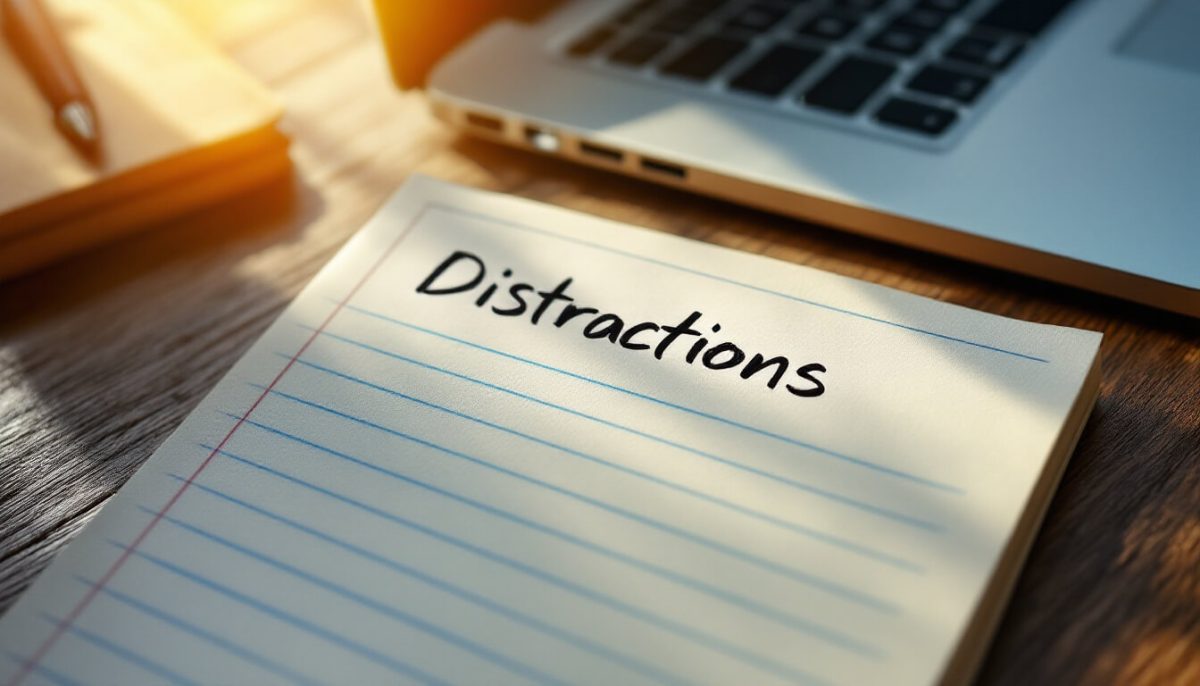
This practice has been remarkably effective. The physical act of writing something down seems to satisfy that part of my brain that insists on holding onto the thought. After my focus session ends, I review the notes and address anything that still needs attention.
How My Work Changed After Rebuilding Focus
After about a month of these practices, I started noticing significant changes:
- First, the quality of my work improved. When I compared writing I did during fragmented attention periods with writing done in focus containers, the difference was striking. The focused work had better flow, fewer errors, and more original thinking.
- Second, I started enjoying my work more. There’s a satisfaction that comes from giving something your full attention that’s missing when you’re constantly switching between tasks. Those 45-minute focus containers often put me in a state of flow that had become rare in my fragmented work pattern.
- Third, I discovered I actually saved time. Tasks that used to take me an entire afternoon of distracted work now get completed in two or three focus containers. It turns out that attention switching has a significant time cost – more than I had realized.
Perhaps most surprisingly, these changes started to affect my non-work life too. I found myself more present in conversations and more engaged in activities that used to compete with my phone for attention. The ability to focus isn’t just for work – it improves everything that benefits from your full presence.
Starting Small: A Simple Path Back to Focus
If your attention feels fragmented like mine did, here’s a simple way to start rebuilding:
Week 1: Measure your current state. Without trying to change anything yet, simply notice how long you can stay focused on one task before feeling the pull to switch. Use a timer and just observe. This creates awareness and gives you a baseline.
Week 2: Create two 20-minute focus containers each day. Set a timer, close unnecessary tabs and apps, silence notifications, and work on just one thing. Put a small notepad nearby for distraction notes. Don’t worry if it’s difficult – that’s normal.
Week 3: Add a physical reset before each focus container. Develop a simple 1-2 minute routine that creates a boundary between distracted time and focus time.
Week 4: Experiment with your environment. Try different sound backgrounds, workspace arrangements, or times of day. Notice what helps and what hinders your focus.
The key is consistency and patience. Your focus didn’t fragment overnight, and it won’t rebuild instantly either. But even small improvements make a noticeable difference in how your work feels and what you can accomplish.
When Focus Still Breaks (Because That’s Life)
Even with all these practices, there are still days when focus is harder to find. High-stress periods, poor sleep, or personal concerns can all affect your ability to concentrate. The difference now is having tools to work with those challenges rather than just accepting fragmented attention as inevitable.
On difficult days, I scale back to shorter focus periods – sometimes just 15 minutes instead of 45. I use my reset ritual more frequently. I’m also more selective about which tasks I tackle, saving the most focus-intensive work for better days when possible.
The goal isn’t perfect, uninterrupted focus every minute of every day. It’s having the capacity for deep focus when you need it, and the awareness to recognize when your attention is fragmenting so you can respond intentionally.
Building back focus capacity in a constantly distracting world isn’t easy. But unlike many digital challenges, this one has straightforward, practical solutions that actually work. The first step is simply deciding that your attention is worth reclaiming.